
Sustain calls for stronger food system protections in the next London Plan
Sustain has responded to the Draft London Plan 2026 consultation, warning that urban agriculture and small food businesses are being overlooked at a time when London needs to build up resilience to future food shocks.
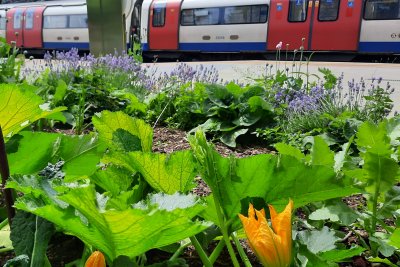 Courgettes growing at Finchley Central station. Credit: Naomi Paine
Against a backdrop of the hottest summer on record and droughts causing terrible growing conditions for UK farmers and key overseas regions, Sustain believes food receives too little attention in the draft London Plan, with key policies from the current London Plan either weakened or removed altogether.
Sustain wants to see greater protection and support for food growing, on the green belt and inner city; community food infrastructure and assets like local businesses, cooperatives, shops and markets that get food to Londoners, and create healthy food environments.
While the Draft London Plan seeks to balance ambitious housing targets with economic growth and climate resilience, it largely fails to address one of the most significant risks arising from climate change: food insecurity. Extreme weather events are already affecting food production around the world, while disruptions to trade, energy and farming inputs continue to affect food prices and availability.
At a time when cities should be planning for greater food resilience, Sustain is concerned that the draft plan weakens London's strategic commitment to food growing, healthy food environments and critical community food infrastructure.
Supporting farming and urban food growing
A particular concern is the removal of Policy G8 on food growing, which currently provides strategic support for urban agriculture and community food growing across London.
Sustain is also concerned about proposals that could weaken protections for London's Green Belt. The farmland surrounding the capital is not simply land awaiting development. Managed well, it can provide multiple benefits, producing food while supporting climate adaptation, biodiversity recovery, flood management and community wellbeing. Sustain support the draft plan’s Brownfield-first approach and is calling for grade 1 and 2 farmland on the greenbelt to receive greater protection.
More support for local food infrastructure
Beyond food production, the draft plan gives insufficient attention to the wider infrastructure that supports London's food system. The draft also drops E9 - a dedicated strategic policy covering markets, healthy food retail and food access, reducing the visibility of food within the planning framework. Markets, food hubs, storage and distribution facilities, community kitchens and local food enterprises all help ensure Londoners can access healthy, affordable and culturally appropriate food. Yet these assets are scattered across different sections of the draft plan, rather than being recognised as part of a connected food system.
Securing healthy food environments for children
Sustain is also calling for stronger protections for healthy food environments, following proposed changes that dilute existing policies on hot food takeaways, including the removal of explicit references to concentrations near schools.
Rachel Dring, Capital Growth Coordinator at Sustain, said:
"It’s short-sighted to downgrade food within London's planning framework. Food is critical infrastructure, every bit as important as transport, energy or housing. The next London Plan must recognise the value of food-growing, protect the Green Belt, and create the conditions for a diversity of shops, markets, community kitchens and cooperatives to provide better access to healthier and more sustainable food for all Londoners."
Sustain is calling on the Greater London Authority to restore a coherent strategic approach to food in the final London Plan, including stronger support for food growing, protection for productive Green Belt farmland, and recognition of food-system infrastructure as essential to London's health, economy and resilience.
15/10/2026


Support our work
Your donation will help communities grow more food in gardens across London.
Capital Growth is a project of Sustain: the alliance for better food and farming.
London's driest July in 190 years: how urban growers are coping in extreme heat
London is Good to Grow: local food gardens open to the public this April
Grassroots campaigners are victorious as Hackney Council passes the Right to Grow