
Food resilience isn't a cupboard full of tins
Last week, Environment Secretary Angela Eagle advised the public to stock up on tinned goods in case of disruptions to Britain’s food and energy supply. But not everyone can afford to do so. Our Capital Growth Coordinator Rachel Dring takes a look at communities across London offering the alternatives, and argues true resilience means far more support for UK growers.
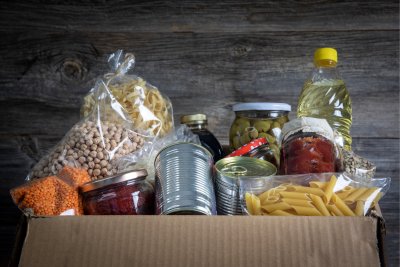 Credit: Esin Deniz / iStock
As Transition Town founder Rob Hopkins put it, telling people to stockpile is an "I" solution, not an "us" solution. And while this is a standard piece of advice that governments give their citizens, it assumes spare cash, cupboard space, and no immediate hunger to solve first. What about the people who already can't feed their families for a day, let alone stockpile against a shock that hasn't happened yet? With an estimated 12% of UK households currently experiencing food insecurity and the projected 6% inflation on food prices by 2027, well-meant advice like this quietly divides us into the haves and the have-nots.
There's a better story than that one, already being written in gardens, allotments and pocket parks across London.
Building civil-food resilience through community mobilisation
The minister's advice followed Tim Lang’s Just in Case report in February 2025 for the National Preparedness Commission. A stark warning that after decades of "just-in-time" logistics, the UK has almost no plan for what happens to ordinary people's food supply during a disruption or crisis. This summer's extreme weather and the war in Iran have sharpened that risk.
Where it's more hopeful is in what it finds already happening locally: people organising to grow, cook and share food when the usual systems fail - exactly the "us" solution Hopkins was calling for. We saw this during the Covid lockdowns, when volunteers across London mobilised to cook meals, deliver parcels and grow fresh veg for food banks almost overnight. Sustain's community harvest campaign recorded 5.5 tonnes of hyper-local fresh food distributed to an estimated 6,945 households within the network in 2020.
Maximising urban space to grow our own food
There’s another way to look at the problem and the answer sits in plain sight: all the unused land in our neighbourhoods and urban fringes that could be growing food instead of nothing. Our network of 2,000+ food growing spaces in London shows this can take many forms, from allotment rows to community gardens, to something older, more climate resilient and lower-maintenance: food forests - layered plantings of fruit and nut trees, berry bushes and perennial vegetables that mimic a woodland's structure, need little input once established, and cope well with drought. Admittedly I used to see food forests as an offbeat idea, but in our current context it’s making much more sense. London-based permaculture designer Rakesh “Rootsman Rak” is mapping the food forests that already exist across the capital, with a modest goal of at least two per borough.
Andernach in Germany shows how far this idea can go: since 2010, its parks, even its castle moat, have become open-access vegetable gardens, "picking allowed" where "keep off the grass" once stood.
Taking over unused public land for a Right to Grow
The national Right to Grow campaign is a simple, low-cost idea gathering pace. Initiated by Incredible Edible in 2021, and with almost no funding behind it, people across the country are mobilising within councils and communities to get on the land and get growing.
The Right to Grow campaign asks councils and other landowners - housing associations, TfL, the NHS - to identify unused public land and set up a simple, transparent process for people to apply to grow food on it. Instead of years of ad hoc negotiation, battling bureaucracy and inertia just to plant some vegetables on a verge, Right to Grow asks for a clear route: here is the land, here is how you apply, here is who to ask.
Waltham Forest's local campaign has already identified 10,000 square meters of extra food growing space in Waltham Forest (a fraction of the land available), to grow 120,000kg of organic fruit and veg to help communities support themselves. They are still raising the funds and working with the council to gain permission to start digging - a telling sign of the gap between appetite and access.
In Southwark, where a Right to Grow has been successfully implemented for two years, the council’s food growing officers have created 27 new community gardens, with a total of 300 plots / raised beds, mostly on housing estates.
While these examples are very London-centric, this idea began in Todmorden in West Yorkshire and momentum across the UK has been building, driven almost entirely by volunteers. Some councils remain resistant; others, including several with growing Green Party representation, are starting to move. What's missing isn't enthusiasm, it's a faster response from local government and the unlocking of funds to enable wider participation.
Tapping into existing knowledge
Access to land solves half the problem; the other is skill. There's a deep well of horticultural knowledge inside London's communities, much of it carried by people who migrated here from places with a closer relationship to land-based work. In my own neighbourhood, for instance, the most capable growers are mostly of Bangladeshi and Indian heritage, knowledge that rarely gets formally recognised, let alone paid for. That points to another piece of the puzzle: paying community growers to share what they know, along the lines of Friends of the Earth's "Postcode Gardener" model and John Little's case for treating land care as infrastructure, what he calls "care not capital", rather than unpaid goodwill.
Embedding effective food governance to support our growers
With around 82% of the UK population urbanised, urban growing can't be sidelined, but at population scale it will not feed a city - it's only one part of a much bigger picture.
We need a horticulture sector properly backed by government rather than left to compete on the margins, and a shift toward agroecological farming that’s less reliant on imported fertiliser and pesticides, combining nature-friendly land stewardship with genuinely productive output. We also need peri-urban farms on the edges of our cities producing fresh fruit and veg at scale and training more people in productive growing skills.
None of that’s possible without a food economy and local food infrastructure built to support it, which is why over 100 organisations are calling for a Good Food Bill - a statutory framework to grow the UK's own food supply, reduce reliance on imports and plan for resilience instead of reacting to the next shock.
Growing for survival, connection and hope
Abeng Community Garden in Lewisham is perhaps a hopeful place to end. Set up by a group of women of Afro-Caribbean heritage who wanted to grow culturally appropriate food and medicinal plants for their community - food that's good for health, and food that's affordable. It exists because their community has long been let down by the state. So they're growing for survival, for connection, for hope and doing it with real joy and generosity.
That's the resilience worth building. Not a cupboard full of tins, but a neighbourhood full of growers and a community that’s better connected.
09/09/2026


Support our work
Your donation will help communities grow more food in gardens across London.
Capital Growth is a project of Sustain: the alliance for better food and farming.
London's driest July in 190 years: how urban growers are coping in extreme heat
London is Good to Grow: local food gardens open to the public this April
Grassroots campaigners are victorious as Hackney Council passes the Right to Grow